Mrs Chandler leads the teaching of English in school.
Our Intent for English
Our Literacy curriculum is designed to meet the content requirements of the DFE’s ‘National Curriculum in England: English Programmes of Study’ (2014) and the language and literacy sections of the ‘Statutory Framework for the Early Years Foundation Stage’ (2014).
Our curriculum aims to develop pupils’ competence in reading, writing, speaking, and listening; this is to ensure that our pupils can become competent users of language. The development of these literacy skills will ensure that pupils can access the whole curriculum effectively and achieve their potential.
At Carr Hill Community Primary School we believe that a quality English curriculum should develop children’s love of reading, writing and discussion. One of our priorities is helping children read and develop their all-important comprehension skills. We recognise the importance of nurturing a culture where children take pride in their writing, can write clearly and accurately and adapt their language and style for a range of contexts. We want to inspire children to be confident in the art of speaking and listening and who can use discussion to communicate and further their learning.
We believe that children need to develop a secure knowledgebase in Literacy, which follows a clear pathway of progression as they advance through the primary curriculum.
The Implementation of English
These aims are embedded across our literacy lessons and the wider curriculum. We have a rigorous and well organised English curriculum and framework, that provides many purposeful opportunities for reading, writing and discussion. We use a wide variety of quality texts and resources to motivate and inspire our children. Teachers also ensure that cross curricular links with concurrent topic work are woven into the programme of study.
The national curriculum for English aims to ensure that all pupils:
- read easily, fluently and with good understanding
- develop the habit of reading widely and often, for both pleasure and information
- acquire a wide vocabulary, an understanding of grammar and knowledge of linguistic conventions for reading, writing and spoken language
- appreciate our rich and varied literary heritage
- write clearly, accurately and coherently, adapting their language and style in and for a range of contexts, purposes and audiences
- use discussion in order to learn; they should be able to elaborate and explain clearly their understanding and ideas
- are competent in the arts of speaking and listening, making formal presentations, demonstrating to others and participating in debate.
Writing at Carr Hill Community Primary School is taught through daily English lessons and the use of a quality texts. Daily English sessions include vocabulary, grammar and punctuation development. In order to help us to develop confident, enthusiastic writers who can express themselves in a variety of different styles and across a variety of contexts, our teaching of writing is often cross circular and linked to our class topics. This provides our children with regular opportunities to write for a range of purposes and audiences. Writing tasks are specific and meaningful, and often meet a purpose to engage children and to illustrate how their writing skills can be applied to real life contexts.
Reading at our school is delivered through reading practise sessions in Reception and Key Stage One. Children have three reading practise sessions each week consisting of a decoding, prosody, and comprehension lessons. Within Key Stage 2 children will have a range of reading opportunities including group reading practice, whole class reading and we use ‘Reading Plus’ in Year 5 & 6 to help improve fluency, comprehension, vocabulary, stamina, and motivation within reading This can also be accessed from home. Through weekly discussion and reflection with peers and staff, children develop the skills and strategies that they need to become competent and fluent readers, as well as learning to recognise the language features of different text types. In conjunction with our progressive approach to writing, we ensure that reading is at the centre of our learning by using quality texts to deliver English lessons.
Reinforced by the provision of weekly home reading books, careful selection of texts has the dual purpose of seeding the desire to read for enjoyment. By introducing our pupils to engaging, exciting and stimulating texts we develop the habit of reading widely and often, for both pleasure and information.
Each class also have discrete comprehension, handwriting and basic skills sessions within their weekly timetables. Where appropriate these sessions are linked to the texts the children are currently exploring.
The Impact of English
The impact on our children is evidenced by their progress, sustained learning and transferrable skills. Throughout reading and writing sessions, children learn to identify the key language features within each writing genre and the basic skills in writing are continually reinforced. We aspire that all pupils will make good progress from their own personal starting points. By the end of Year Six they will be able to read and write fluently, clearly and accurately and adapt their language and style in and for a range of contexts, purposes and audiences.
With the implementation of the writing journey being well established and taught thoroughly in both key stages, children are becoming more confident writers and by the time they are in upper Key Stage 2, most genres of writing are familiar to them and the teaching can focus on creativity, writer’s craft, sustained writing and manipulation of grammar and punctuation skills.
As all aspects of English are an integral part of the curriculum, cross curricular writing standards have also improved and skills taught in the English lesson are transferred into other subjects; this shows consolidation of skills and a deeper understanding of how and when to use specific grammar, punctuation and grammar objectives. We hope that as children move on from us to further their education and learning that their creativity, passion for English and high aspirations travel with them and continue to grow and develop as they do. As a result, we have a community of increasingly enthusiastic readers and writers who enjoy showcasing their developing literacy knowledge and skills. They are confident to take risks in their reading and writing, and love to discuss and share their ideas.
Our English Curriculum Overview
DfE PRIMARY_National_Curriculum_-_English
English Curriculum
Teachers will be using the documents below to ensure that all children have access to a comprehensive and age appropriate English curriculum.
The following documents support the English curriculum that we have mapped out for our pupils. The documents are to support the long, medium and short term planning processes to ensure both full coverage and progression in English.
Planning


 Type
Date added
Type
Date added
- CHPS NURSERY English Mapping 1.pdf pdf192.9 KbMar 15th, 2023

- CHPS REC English Mapping .pdf pdf217.1 KbJan 24th, 2023
- CHPS Y1 English Mapping Cycle 1 2026.pdf pdf265.5 KbJan 7th, 2026
- CHPS Y1 English Mapping Cycle 2 2026.pdf pdf265.7 KbJan 7th, 2026
- CHPS Y2 English Mapping Cycle 1 2026.pdf pdf255.5 KbJan 7th, 2026
- CHPS Y2 English Mapping Cycle 2 2026.pdf pdf259.7 KbJan 7th, 2026
- CHPS Y3 English mapping Cycle 1 2026.pdf pdf256.6 KbJan 7th, 2026
- CHPS Y3 English mapping Cycle 2 2026.pdf pdf264.6 KbJan 7th, 2026
- CHPS Y4 English mapping Cycle 1 2026.pdf pdf255.8 KbJan 7th, 2026
- CHPS Y4 English mapping Cycle 2 2026.pdf pdf264.5 KbJan 7th, 2026
- CHPS Y5 English Mapping 2026.pdf pdf221.3 KbJan 7th, 2026
- CHPS Y5 English Mapping Cycle 1 2026.pdf pdf221.3 KbJan 7th, 2026
- CHPS Y5 English Mapping Cycle 2 2026.pdf pdf267.9 KbJan 7th, 2026
- CHPS Y6 English Mapping Cycle 1 2026.pdf pdf218.2 KbJan 7th, 2026
- CHPS Y6 English Mapping Cycle 2 2026.pdf pdf277.6 KbJan 7th, 2026
Writing
Our Writing Process Model
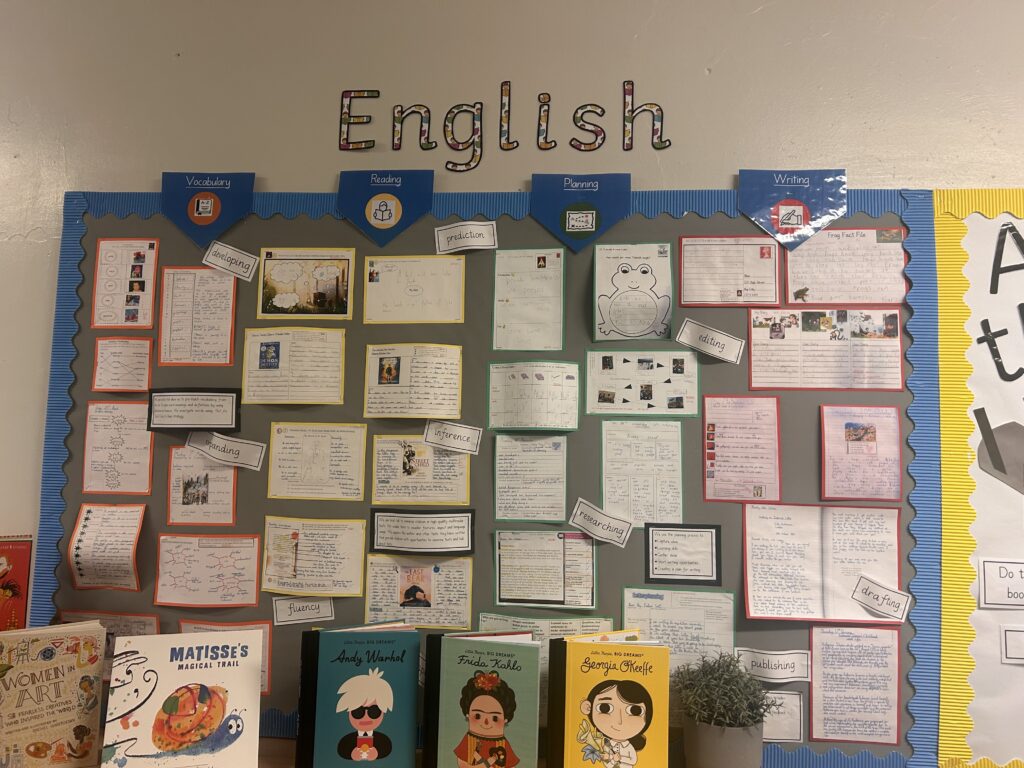
At Carr Hill Community Primary School, we follow a clear Writing Process Model that supports children through each stage of writing. Using high-quality texts and engaging experiences as a stimulus, pupils explore vocabulary, language and text features before planning, drafting, editing and publishing their work. Through teacher modelling, guided practice and opportunities for reflection, children learn that effective writing is a process, helping them to become confident, independent and successful writers.

Genre Mapping Document
At Carr Hill Community Primary School, our Genre Mapping ensures children experience a rich and varied range of writing opportunities throughout their time in school. Through carefully selected texts and meaningful curriculum links, pupils develop the skills to write for different purposes and audiences across fiction, non-fiction and poetry. Genres are revisited progressively across year groups, allowing children to build upon previous learning and develop increasing confidence, creativity and independence as writers. By exploring the language, structure and features of different text types, pupils learn to communicate effectively, adapt their writing to suit different contexts and develop a lifelong enjoyment of writing.
Reading
Reading Progression Document
Spelling
Our medium-term plans provide a clear and progressive roadmap for learning across the school, ensuring that knowledge and skills are carefully built upon from year to year. Each plan is designed to meet National Curriculum expectations while reflecting the needs of our pupils, with regular opportunities for revision, practice and assessment.
A key feature of our curriculum is the development of morphological, orthographical and etymological knowledge. Children learn how words are structured through the study of prefixes, suffixes and root words (morphology), explore spelling patterns and conventions (orthography), and discover the origins and history of words (etymology). This approach helps pupils make connections between words, understand meanings more deeply and become confident, accurate spellers. By revisiting and applying this knowledge across the curriculum, children develop a richer vocabulary and greater independence in both reading and writing.
Our medium-term plans support high-quality teaching and help ensure that every child is challenged, supported and inspired to achieve their full potential.
Poetry
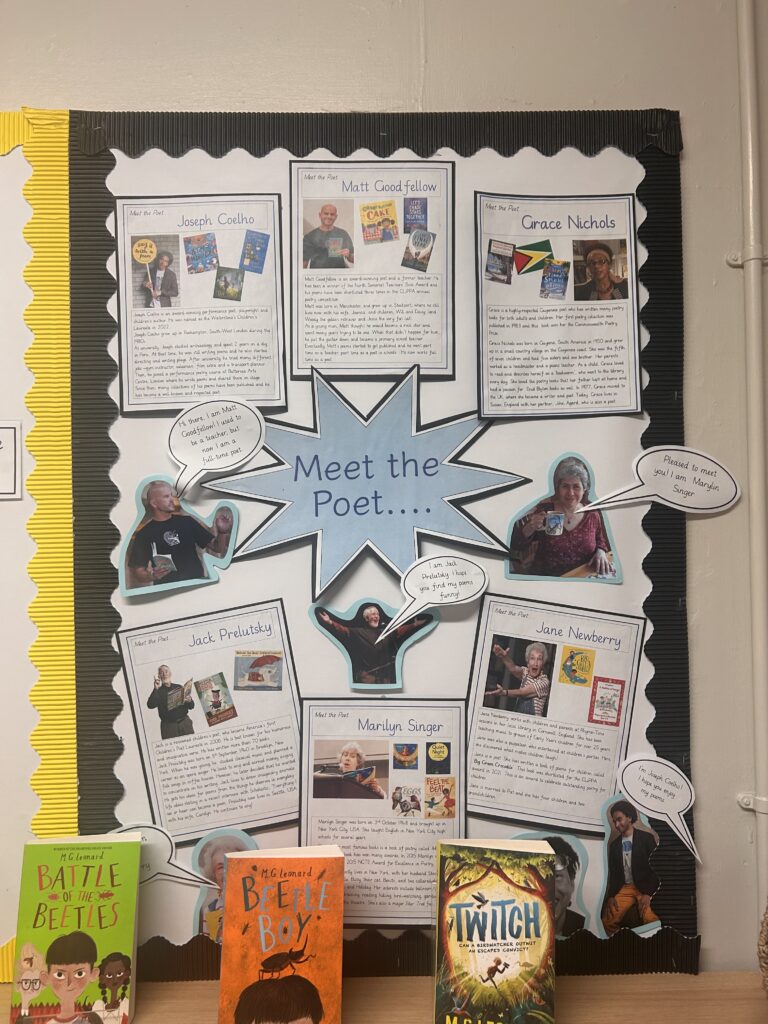
At Carr Hill Community Primary School, we believe that poetry plays a vital role in developing children’s creativity, language and confidence. Our carefully planned poetry curriculum enables pupils to read, explore, perform and create a wide range of poems, while developing a deep appreciation of language and its power. Through the study of both classic and contemporary poets, children learn how poets use words, structure and sound to engage, entertain and inspire readers.
As pupils move through the school, they encounter an increasingly diverse range of poetic forms, including acrostic poems, list poems, reversos, kennings, limericks, shape poems and cinquains. These forms are carefully sequenced to ensure that children revisit and build upon previously taught skills while being introduced to new poetic techniques and structures.
Our poetry teaching places a strong emphasis on close reading and critical discussion. Children explore poems in depth, considering themes, language choices and the impact of different poetic devices. They learn to identify and apply techniques such as repetition, rhythm, rhyme, alliteration, assonance, imagery, similes, metaphors and personification, helping them to become thoughtful readers and effective writers.
Performance is an important aspect of our poetry curriculum. Through speaking, listening and recital opportunities, pupils develop fluency, expression and confidence while gaining a deeper understanding of how poetry is intended to be heard and experienced. Children are encouraged to experiment with language, vocabulary and poetic structures to express their ideas, opinions and emotions creatively. Through this progressive approach, our pupils develop a lifelong appreciation of poetry and the confidence to communicate effectively through both the spoken and written word
Poetry Overview

Poetry Progression
Poetry Plans
Handwriting

At Carr Hill Community Primary School, we use the Letter-join handwriting programme to develop neat, fluent and confident handwriting from the Early Years through to Year 6. The programme provides a clear progression that teaches children how to form letters correctly, develop consistent letter sizing and spacing, and build automatic, joined handwriting skills. Through engaging interactive lessons and regular practice, pupils learn the correct joins and develop the fine motor control needed for effective written communication.
Our approach ensures that handwriting is taught explicitly and consistently across the school, helping children to write with increasing speed, stamina and legibility. Letter-join supports pupils in developing a comfortable pencil grip, correct posture and efficient writing habits, enabling them to focus more fully on the content of their writing. By fostering pride in presentation and high standards across all areas of the curriculum, we help children become confident, independent writers who can communicate their ideas clearly and effectively.

Book Mapping
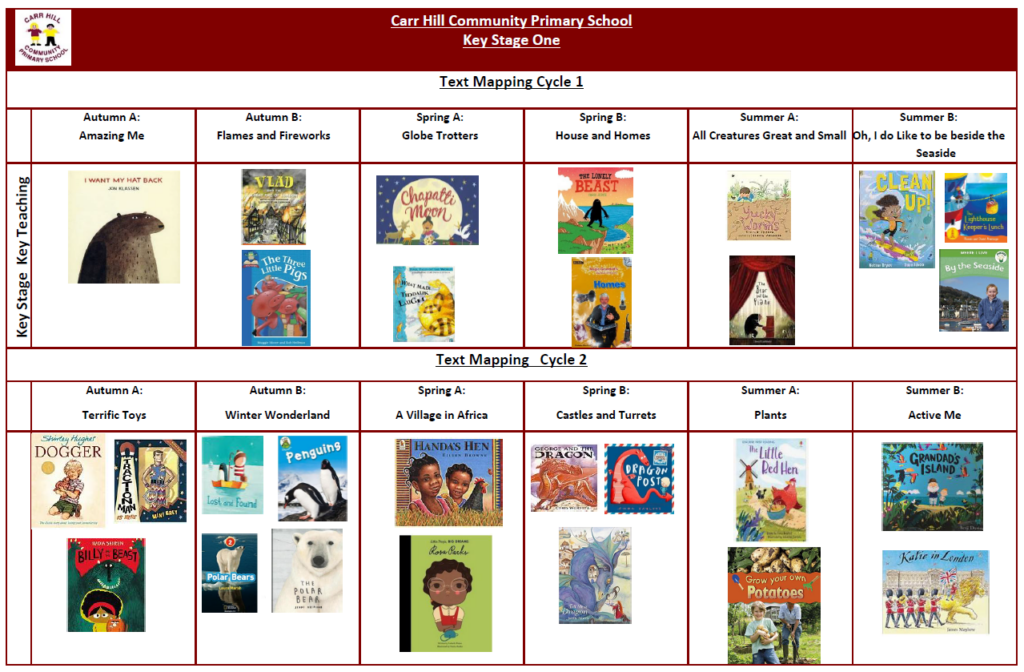
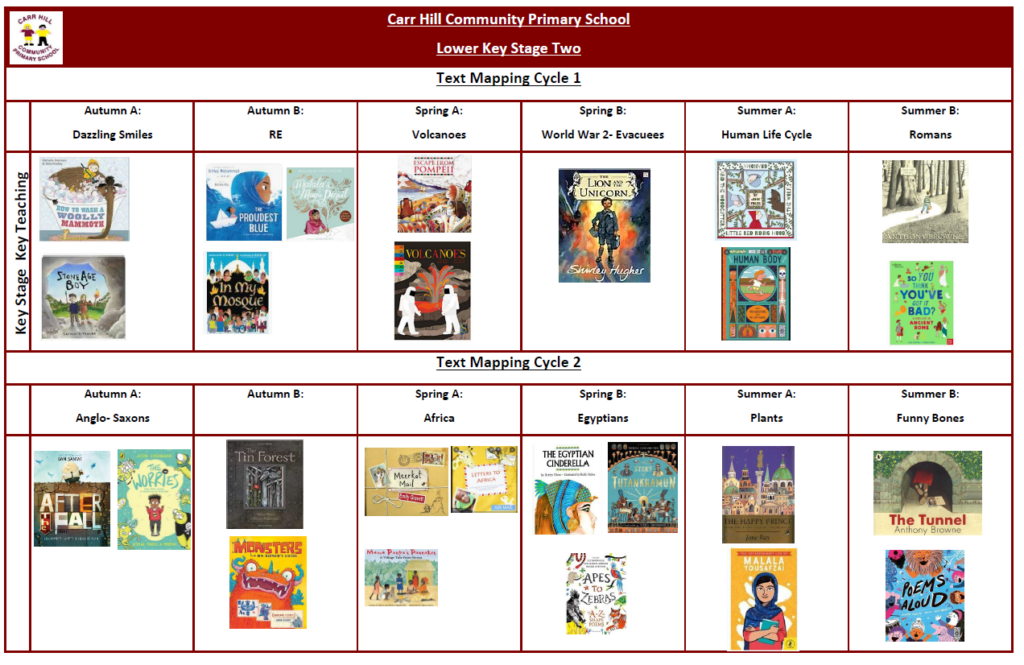
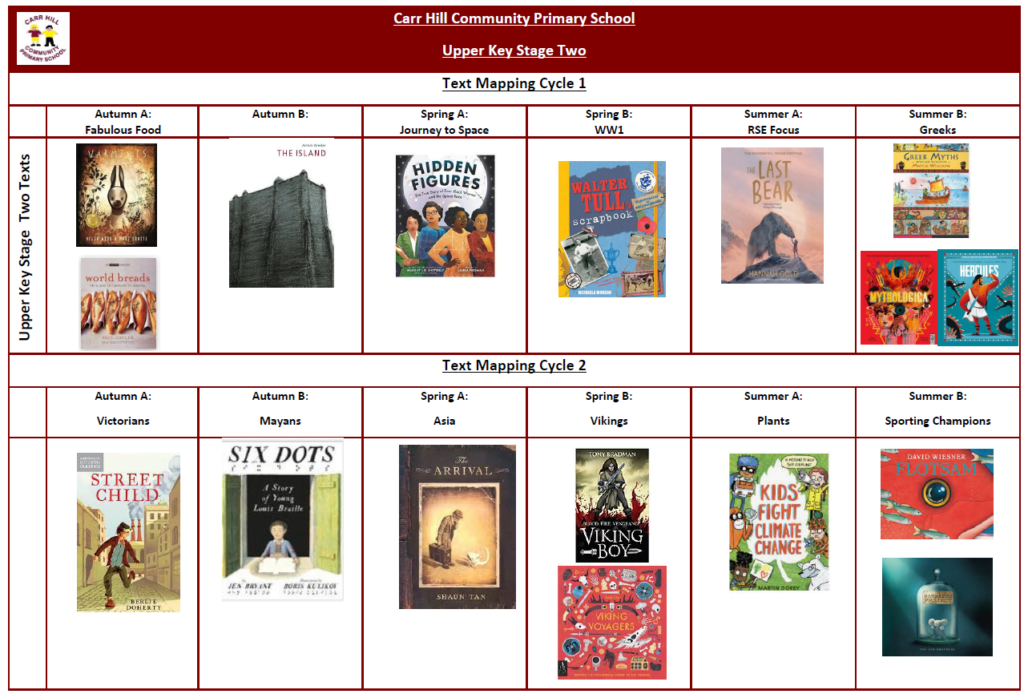
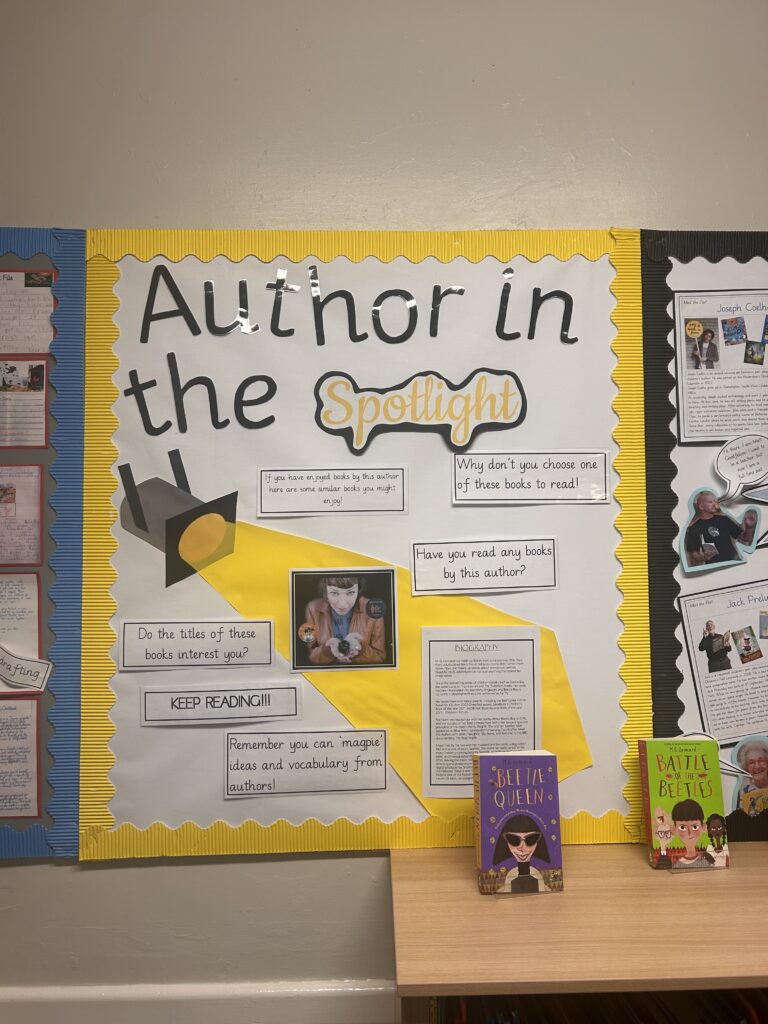
At Carr Hill Community Primary School, our carefully planned Book Mapping curriculum places high-quality texts at the heart of learning. From Nursery through to Year 6, children are immersed in a diverse range of fiction, non-fiction and poetry that has been carefully selected to support curriculum topics, develop knowledge and inspire a lifelong love of reading. Each year group’s text journey is mapped progressively to ensure pupils encounter a rich variety of authors, genres, cultures and themes throughout their time in school.
Our book mapping strengthens links across the curriculum, allowing children to deepen their understanding of topics such as history, geography, science and personal development through meaningful and engaging literature. Texts are used as a vehicle for developing reading comprehension, vocabulary acquisition, oracy and high-quality writing, enabling children to make purposeful connections between subjects.
We carefully select books that act as both mirrors and windows: mirrors that allow children to see themselves and their experiences reflected in literature, and windows that provide opportunities to explore different cultures, perspectives and worlds beyond their own. Through regular exposure to ambitious vocabulary, rich language and powerful storytelling, our pupils develop the knowledge, empathy and cultural capital needed to flourish as confident readers and learners.
Our book mapping ensures that every child experiences a broad, balanced and inspiring reading journey, building strong foundations in reading while nurturing curiosity, imagination and a genuine passion for books.